The sign gets all the attention, but the post and the hole in the ground under it decide whether that sign is still standing straight after the first windstorm, the first snowplow, or the first car that clips it. Choose the post badly and you get a bent face within a season, a sign that spins on a loose pole, or a genuine hazard where a post should have yielded and did not. The choice comes down to four things: the post family, its weight, how deep you set it, and the hardware that holds the sign on. None of it is complicated once you match each one to the sign and to the site.
Match the post family to the sign and the setting
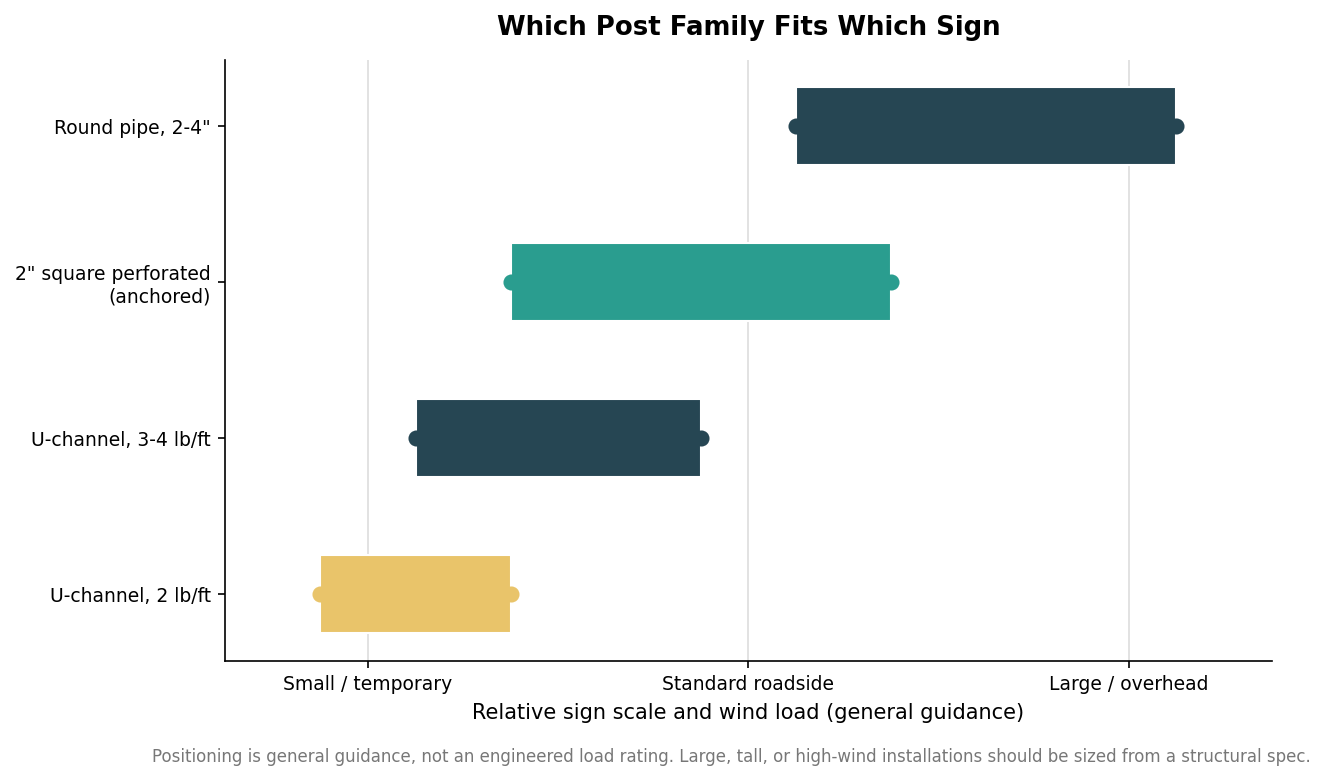
Three post families cover almost every job. U-channel posts are hot-rolled from 12-gauge rail steel, drive straight into the ground, and are the workhorse for small and temporary signs, parking lots, and low-speed residential streets. Square perforated tube, usually 1.75 or 2 inches across with holes punched on every side, is the urban and multi-sign choice: the perforations let you bolt signs facing any direction and let the post telescope into a buried anchor sleeve, so a damaged post pulls out and a fresh one drops in without re-digging. Round pipe, from roughly 2 to 4 inches in diameter, is what carries large, tall, or overhead directional signs along high-traffic roads. The chart below places each family against the rough scale of sign it suits. Read it as a way to narrow the field, not as a load rating.
For U-channel, the weight per foot is the real decision
U-channel posts are sold by weight per foot, most commonly 2, 3, and 4 pounds. That number is a proxy for stiffness. A 2-pound post is fine for a single small sign in a sheltered spot, but it will flex and lean under a larger face or in an open, windy location, where stepping up to 3 or 4 pounds per foot buys the rigidity to keep the sign flat and plumb. The other lever is simply using two posts. Any sign much wider than about two feet sits far steadier, and is much less prone to twisting in the wind, on a pair of posts than it is fighting to stay square on a single one. As a rough calibration, a small regulatory or parking sign on a sheltered street is comfortable on a 2-pound post, while a 24-by-30-inch face, or anything on an exposed corner, is the point at which most installers move up to a 3-pound post and start considering the second one. Deciding the weight and the post count up front is a great deal cheaper than replacing a bent post after the fact.
How deep to set it
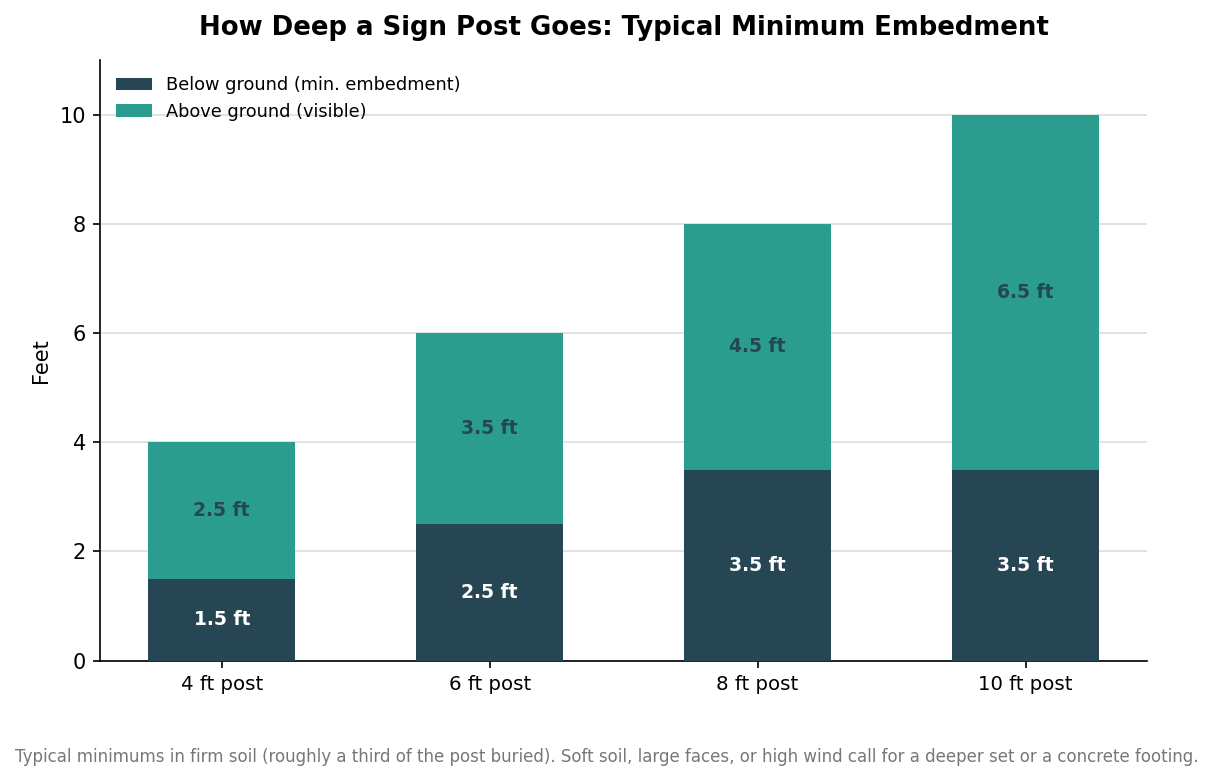
A sign tends to fail at the ground before it fails anywhere else, so embedment is not the place to economize. The working rule of thumb is to bury roughly a third of the total post length, which in practice means a 4-foot post set about 1.5 feet deep, a 6-foot post about 2.5 feet, and 8- to 10-foot posts around 3.5 feet down. The chart below shows how that splits between what is buried and what stays visible above grade. Those figures are minimums for firm soil; soft or sandy ground, a large sign face, or a high-wind exposure all argue for going deeper or setting the post in a concrete footing, and in cold climates you want the base below the frost line so seasonal heaving does not slowly lift it. A driven anchor sleeve is the tidy alternative, letting the visible post slot in and out for quick replacement without touching the footing. Driving a post with a manual driver is faster than digging where the soil is workable, but it only succeeds in ground free of rock; where you hit rock or decide on a concrete footing, plan on augering the hole instead.
Breakaway and hardware are not optional extras
Two details separate a professional installation from a liability. The first is breakaway behavior. A post standing inside the roadside clear zone is expected to yield if a vehicle strikes it, which is why light U-channel posts are allowed to bend on impact while larger round and square posts are fitted with slip bases or breakaway couplers that release. A rigid, over-built post in the wrong spot can turn a minor run-off-the-road into a serious crash, so the breakaway approach has to match the location, not just the sign. The second detail is the fastening hardware: theft-resistant or one-way bolts so signs do not walk off, nylon washers so the hardware neither cracks the sheeting nor bites through the face, and a windbeam or a second post to stiffen a wide panel. Galvanized steel is the default for corrosion resistance, with baked-enamel finishes reserved for places where the post color itself matters.
Spec the whole assembly, not just the sign
The habit that prevents callbacks is to quote the sign, the post, the footing, and the hardware together, as one assembly sized as a unit. A sign is only as reliable as the weakest of those four parts, and the failures that bring a crew back out are almost never the aluminum blank itself; they are an undersized post, a shallow hole, or cheap bolts. Spend the extra few minutes matching the post family, its weight per foot, the burial depth, and the fasteners to the sign and its setting, and the installation goes on doing its job quietly for the fifteen or twenty years the sign face is built to last.