Use regulatory road signs where drivers must follow a rule, such as stop, yield or no parking, and warning road signs where drivers need advance notice of a hazard, such as a curve, crossing or speed hump. Customized Road Signs makes both types to order, and many spots need a pair: a warning ahead and a regulatory sign at the point itself.
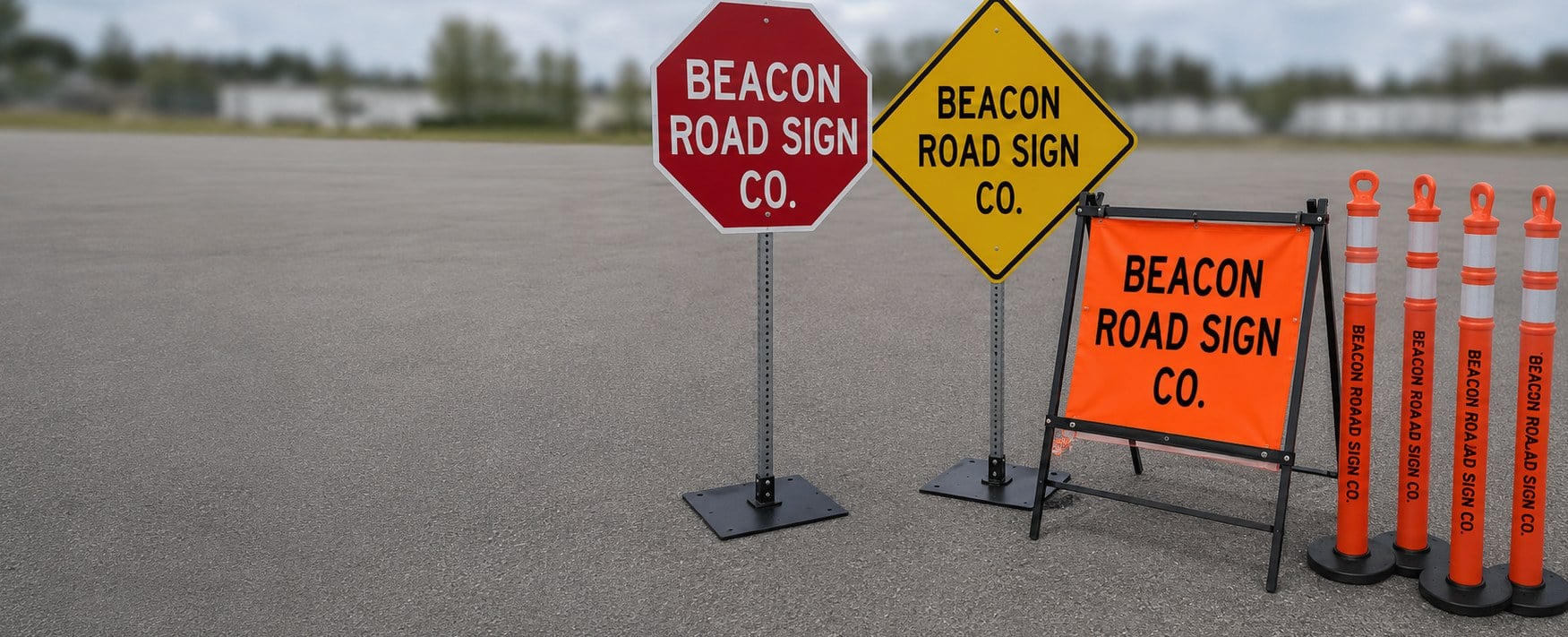
- Regulatory road signs give commands; warning road signs describe what is ahead.
- Warning signs stand ahead of a hazard; regulatory signs stand at the point the rule applies.
- Many locations need a pair: a warning in advance and a regulatory sign at the spot.
- Customized Road Signs returns a free mockup within 24 hours, with unlimited revisions.
- Standard turnaround is about 2 weeks after approval; pay nothing until you approve.
What is the difference between regulatory and warning road signs?
Regulatory road signs tell drivers what they must or must not do, such as stop, yield, keep right, no parking or obey a posted speed. Warning road signs tell drivers what is ahead so they can adjust, such as a sharp curve, a pedestrian crossing, a speed hump or a blind driveway. One gives an instruction; the other gives a heads-up.
That difference drives almost every other choice on a custom road sign order: the shape and color, the wording style, where the sign stands relative to the hazard or rule, and how bright the sheeting needs to be. Drivers recognize the two families instantly. Regulatory road signs are mostly white rectangles with black legends, plus the red stop octagon and yield triangle. Warning road signs are typically yellow or fluorescent yellow-green diamonds with black symbols or short legends.
On a private road, campus or business park, mixing the two up is the most common sign-plan error. A yellow diamond that says “No Trucks” reads as advice, not a rule, and a white rectangle announcing a hidden curve looks like a policy notice. Getting the family right first makes every later decision easier.
Which road sign type should I use at each spot on my property?
Use a regulatory road sign wherever you need drivers to follow a rule at that exact point, and a warning road sign wherever drivers need advance notice of a condition they might not see in time. A practical test: if a driver who ignores the sign is breaking your property rules, it is regulatory; if a driver who ignores it might be surprised, it is a warning.
| Spot on the property | Usually needs | Why |
|---|---|---|
| Intersection of two internal drives | Regulatory (stop or yield) | Assigns right of way at that point |
| Approach to a speed hump | Warning | Drivers need to slow before they reach it |
| Fire lane or loading zone | Regulatory (no parking, no standing) | States a rule that can be enforced |
| Pedestrian crossing near an entrance | Warning, sometimes paired with a regulatory yield | Alerts drivers ahead, then tells them what to do |
| Private road entrance | Regulatory (speed limit, private property rules) | Sets expectations for the whole road |
| Blind curve or hidden driveway | Warning | Describes a hazard the driver cannot see yet |
Many locations need both: a warning road sign in advance and a regulatory road sign at the point itself. A pedestrian crossing is the classic pair. Mark each pair on your sign map so they are quoted and installed together.
How should wording differ on regulatory and warning road signs?
Regulatory road sign wording should be a short command, and warning road sign wording should be a short description of what is coming. “No Parking Fire Lane”, “Trucks Keep Right” and “Residents Only Beyond This Point” are commands. “Speed Hump Ahead”, “Hidden Driveway” and “Forklift Crossing” describe a condition and leave the driver to react.
Keep both types brief. Drivers read road signs for a moment at speed, so cut every word that does not change what they do. Warning road signs work best with a familiar symbol, such as a pedestrian, a curve arrow or a bump, and little or no text. Regulatory road signs often need text because the rule is specific to your property, which is where custom legends earn their place.
- Regulatory: start with the verb or the restriction; add the reason only if it helps compliance, such as “Fire Lane”.
- Warning: name the hazard and, where useful, the direction or distance in words such as “Ahead”.
- Both: keep logos small and outside the core message.
Customized Road Signs reviews every legend on the free mockup, returned within 24 hours, and will tighten wording as many times as you need.
Do regulatory and warning road signs need different reflective sheeting?
Regulatory and warning road signs often benefit from different reflective sheeting because they do different jobs at different distances. A warning road sign must be read well before the hazard, so it usually deserves the brighter grade on any road where drivers move quickly or lighting is poor. A regulatory road sign at a lit, slow intersection can often use a standard grade, as long as every regulatory sign on the property matches.
The bigger risk is inconsistency. When some stop signs glow in headlights and others look dull, drivers notice the bright ones and miss the rest. Choose a grade by road type and lighting, then apply it to every sign of that type along the same route.
- Fast approach roads and dark entrances: brighter sheeting for both types.
- Warning signs ahead of curves, crossings and hidden hazards: favor the brighter grade.
- Slow, well-lit internal drives: a standard grade, matched across the site.
The high-reflectivity signs page lists the sheeting options Customized Road Signs offers, and you can ask for a grade recommendation sign by sign on your quote request.
Where should regulatory and warning road signs be placed?
Regulatory road signs belong at the point where the rule applies, and warning road signs belong ahead of the hazard with enough room for a driver to react. A stop sign sits at the stop line; a warning for a speed hump sits before the hump, far enough back that a driver at normal speed can slow comfortably.
Placement also decides how many road signs you need. A no-parking rule along a long fire lane may need several regulatory signs so the rule is visible along its full length. A curve warning on a two-way road needs one sign for each direction of travel. Walk or drive the route in both directions and note every spot where a driver first needs the information.
- Mark each rule point and each hazard on a site plan.
- Add a warning sign upstream of each hazard, for every direction of travel.
- Add regulatory signs at each rule point, and repeat them along long restricted zones.
- Note the post or mounting surface at every location.
Customized Road Signs supplies posts, brackets and hardware with the road signs, so the mounting plan and the sign plan can be quoted together.
Can custom regulatory and warning road signs carry a logo or private wording?
Custom regulatory and warning road signs can carry private wording, and many can carry a small logo, as long as the sign still reads as its family at a glance. Private roads, campuses, warehouses and communities regularly need rules and hazards that no stock sign covers, such as “Visitors Report to Gate” or “Golf Cart Crossing”.
The safe approach is to keep the familiar shape and color, keep the core legend dominant, and place a logo in a band at the top or bottom. Avoid putting a logo on a stop or yield sign, where any distraction works against the message. Warning road signs usually look best with a symbol and no branding at all.
Facilities with unusual traffic, such as yards with trucks and forklifts, rely heavily on custom legends; the custom road signs for warehouses and industrial facilities page shows typical examples. When you are unsure whether to customize at all, the custom vs. stock road signs guide walks through that choice.
How do I order a mix of regulatory and warning road signs in one quote?
Order a mix of regulatory and warning road signs in one quote by sending a single list that tags each sign by type, legend, size class, sheeting grade, location and mounting. One consolidated list keeps colors, fonts and sheeting consistent and lets Customized Road Signs check that warnings and rules are paired where they should be.
- Number every sign on a site plan or sign map.
- Label each one regulatory or warning, with its exact wording or symbol.
- Note road type and lighting so sheeting can be matched.
- List posts, brackets or other hardware needed.
- Send logos, if any, with the quote request.
Customized Road Signs returns a free mockup within 24 hours, revisions are unlimited, and you pay nothing until you approve the design. Standard turnaround is about 2 weeks after approval, with faster turnaround available through express shipping. Browse regulatory road signs and warning and diamond signs for common types, and see how it works for the full process.
Frequently asked questions
Should a speed hump get a regulatory sign or a warning road sign?
A speed hump is normally marked with a warning road sign placed before the hump, because drivers need advance notice to slow down rather than an instruction at the hump itself. Some properties add a regulatory speed limit sign at the entrance to set the expected pace. Customized Road Signs can mock up both on the same quote so they share sheeting and style.
Can a warning road sign be used to enforce a property rule?
A warning road sign is a poor tool for enforcing a property rule, because its shape and color tell drivers it is advice about a condition, not an instruction. If you want drivers to stop, stay out, keep right or avoid parking, use a regulatory road sign with a clear command. Keep warning signs for hazards drivers might not see in time.
How far ahead of a hazard should a warning road sign stand?
A warning road sign should stand far enough ahead of the hazard that a driver at normal speed can see it, understand it and react comfortably before reaching the hazard. Faster roads need more distance, slow internal drives need less. Walk or drive the approach yourself and note where you would want the warning, then mark that spot on your sign map.
Do I need separate warning road signs for each direction of traffic?
Warning road signs are usually needed for each direction of travel on a two-way road, because a driver approaching from the other side faces the hazard just as suddenly. A curve, crossing or hidden driveway typically gets one sign per approach. Customized Road Signs can quote matching pairs so both directions show the same legend and sheeting grade.
Which is better for a golf cart or forklift crossing, a regulatory or warning road sign?
A golf cart or forklift crossing is usually best served by a warning road sign with a clear symbol placed before the crossing, so drivers expect slow vehicles. If drivers must also yield or stop, add a regulatory road sign at the crossing itself. Customized Road Signs can create a custom symbol or legend for crossings that stock signs do not cover.
Can regulatory road signs on a private road carry our community or company name?
Regulatory road signs on a private road can carry a community or company name in a small band above or below the main legend, as long as the command stays dominant and readable at a glance. Keep stop and yield signs free of branding. Customized Road Signs shows the name placement on a free mockup within 24 hours so you can judge it before production.
What happens if regulatory and warning road signs on one site use different sheeting?
Regulatory and warning road signs with mismatched sheeting along one route can confuse drivers at night, because brighter signs draw the eye and dimmer ones get missed. Choose a sheeting grade by road type and lighting, then use it for every sign of that type on the route. Customized Road Signs can recommend a grade for each sign on your list.
Should temporary hazards use rigid warning road signs?
Temporary hazards such as a short repair, a moved entrance or a seasonal event are often better handled with roll-up or stand-mounted warning road signs that can be removed when the hazard ends. Rigid road signs on posts suit permanent conditions. Customized Road Signs offers work zone and roll-up signs alongside permanent signs, so both can be included on one quote.
How many words should a custom warning road sign have?
A custom warning road sign should use as few words as possible, ideally a familiar symbol with a short legend such as a hazard name and the word ahead. Drivers read warning signs for a moment at speed, so long phrases go unread. Customized Road Signs offers unlimited free revisions on the mockup, which makes it easy to trim wording until the sign reads instantly.
Can one road sign combine a warning and a regulatory message?
Combining a warning and a regulatory message on a single road sign usually makes both harder to read, because the shape and color can only signal one family. A better approach is two signs: a warning in advance and a regulatory sign at the point of the rule, or two panels stacked on one post. Customized Road Signs can mock up either layout for comparison.
What should I list for each sign when quoting regulatory and warning road signs together?
For each sign on a combined quote of regulatory and warning road signs, list the type, exact wording or symbol, approximate size class, road type and lighting, location on your site plan and how the sign will be mounted. Add any logo files. Customized Road Signs uses those details to return a free mockup within 24 hours, and you pay nothing until you approve.
Get a free mockup for your road signs
Send your logo or idea and the quantity you have in mind. Customized Road Signs returns a free mockup within 24 hours, you approve the design before anything is produced, and standard turnaround is about two weeks with faster options available. Get a custom quote.