The size of a road sign is not a style choice. On any road open to public travel, the Manual on Uniform Traffic Control Devices (MUTCD) sets the minimum face dimensions, how high the sign has to sit, and how far it stands from moving traffic. Those numbers change with the number of lanes and the posted speed, and getting them right the first time is the difference between a sign a driver reads cleanly at 55 mph and one a municipal inspector flags for replacement. This guide walks through how to turn a location into a complete sign spec: face size, blank thickness, and installation geometry.
Start with the road, not the sign
Every dimension downstream depends on how you classify the road the sign faces. MUTCD Table 2B-1 lists sizes in columns for a conventional single-lane road, a multilane road, an expressway, and a freeway, and the jump between them is real: a stop sign grows from 30 inches on a quiet residential street to 36 inches where it faces a multilane approach. Posted speed pushes the same direction. For a multilane road with speeds of 45 mph or higher, a 36-by-36-inch STOP sign is the minimum, not the standard 30-inch blank. Before you pick anything, write down three facts about the site: how many lanes the sign faces, the posted or prevailing speed, and whether the road is publicly maintained or private property such as a parking lot, campus, or HOA. On private property the MUTCD is not legally binding, but matching its sizing keeps a sign instantly recognizable and easier to defend if a driver ever disputes it.
The size table that governs your order
Regulatory signs anchor most orders. A STOP sign (R1-1) runs 30 by 30 inches on a single-lane road, 36 by 36 on a multilane road, and 48 by 48 as an oversized blank for high-speed or high-visibility locations. A YIELD sign (R1-2) is an equilateral triangle at 36 inches on a conventional road, 48 inches on a multilane road, and 60 inches on a freeway, with a 30-inch minimum. Speed Limit signs (R2-1) are 24 by 30 inches as the conventional standard, 30 by 36 on multilane roads, 36 by 48 on expressways, and 48 by 60 on freeways, with an 18-by-24-inch floor for the smallest applications. Diamond warning signs follow a similar ladder, 30 by 30 inches on conventional roads and 36 by 36 where speeds and lane counts climb. One useful stability note for anyone reordering against an older spec sheet: the dimensions in Table 2B-1 did not change between the 2009 MUTCD and the 11th Edition published in December 2023, so a size that was compliant a decade ago is still compliant today.
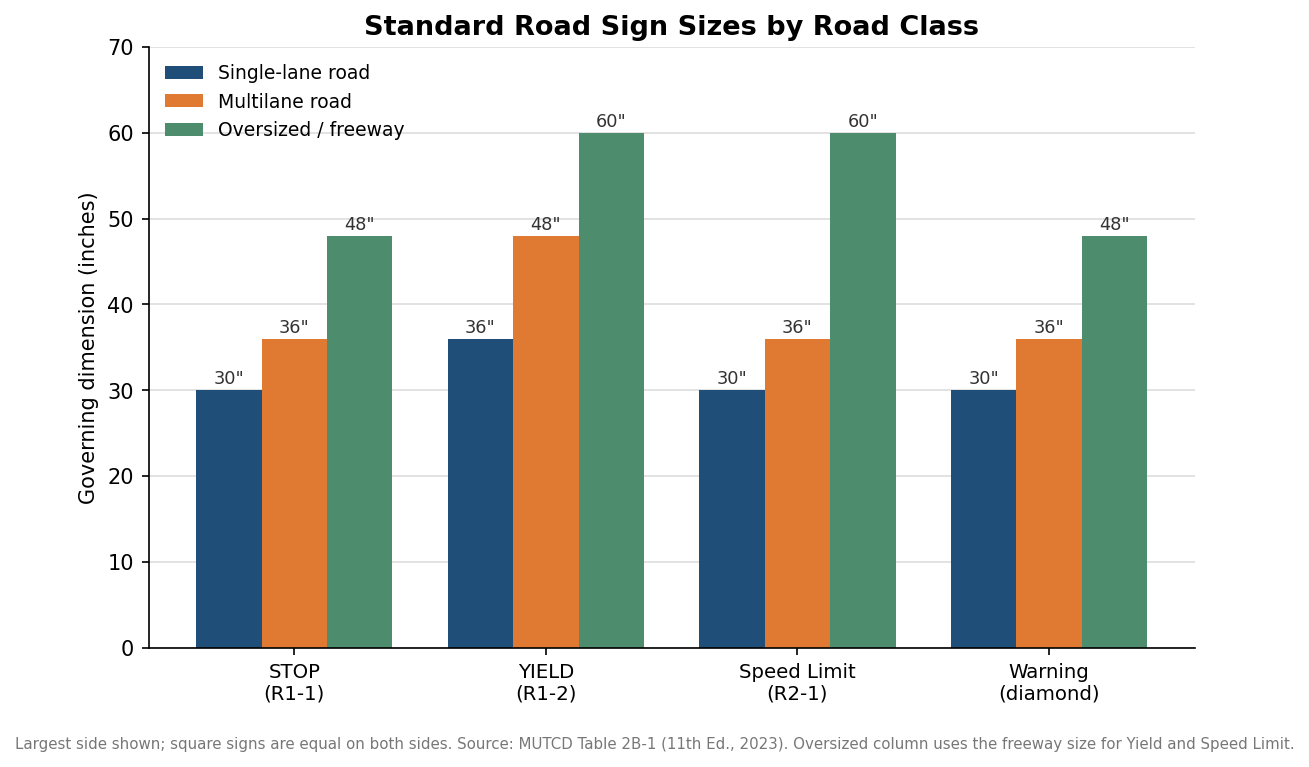
The chart shows the governing dimension, meaning the largest side of each sign. Square signs share that measurement on both sides, and the triangular yield sign measures the same on all three. When a spec sheet lists a single number for a square regulatory sign, that number is both the width and the height.
Aluminum thickness: 0.063, 0.080, and when to go heavier
Nearly all durable road signs are printed on rust-free aluminum blanks, and the trade quotes thickness in thousandths of an inch. A 0.040-inch blank is thin novelty stock and does not belong on a real roadway. The two working thicknesses are 0.063 inch and 0.080 inch, and 0.080 is the common default for signs up to 36 inches, including most stop, yield, speed limit, and street-name blades. Once a sign exceeds 36 inches, 0.125-inch aluminum becomes the typical choice because a large panel needs the extra stiffness to resist flexing and wind load. Standard blanks arrive with rounded corners and pre-punched mounting holes, so you rarely need to specify those separately. As an indicative figure rather than a guarantee, an aluminum blank itself commonly lasts 7 to 12 years outdoors; in practice the reflective sheeting on the face, not the metal, is usually what ages out first and sets the real replacement clock.
Mounting height and setback
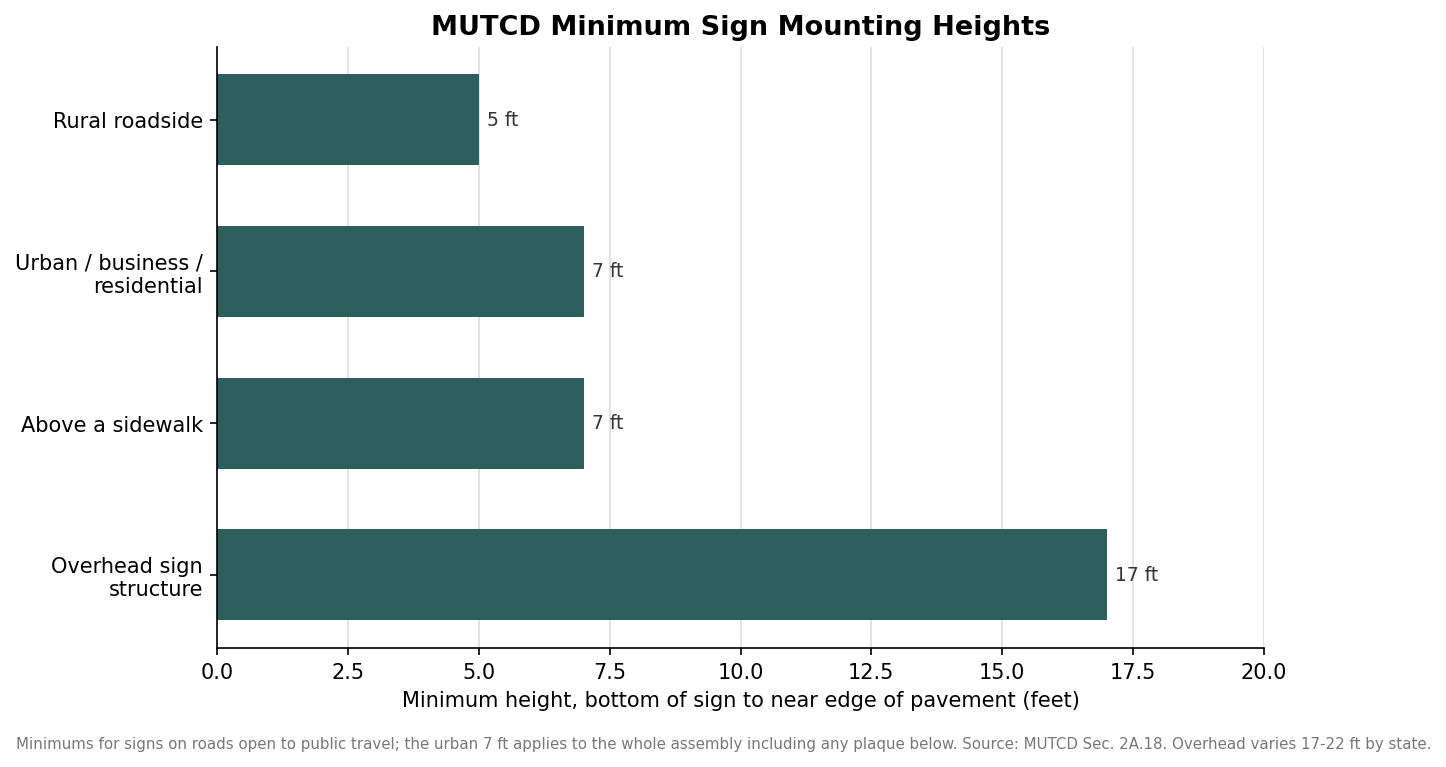
A correctly sized sign still fails if it is hung wrong. The MUTCD sets a minimum height from the bottom of the sign to the near edge of the pavement, and it differs by setting. Rural roadside installations carry a 5-foot minimum, while urban, business, and residential areas require 7 feet, largely so a sign never clips a pedestrian and stays visible over parked cars. That 7-foot rule applies to the entire assembly, so a secondary plaque mounted below the main sign has to clear it too. Overhead sign structures sit much higher, generally 17 feet and up depending on the state.
Lateral placement matters just as much as height. On rural highways the guidance calls for roughly 12 feet from the edge of the traveled way, and at least 2 feet beyond the shoulder edge where shoulders are wide, which keeps the post out of the recovery zone. In tight urban corridors that offset compresses to a minimum of about 2 feet from the face of the curb, enough to keep the panel clear of side mirrors without crowding the sidewalk. Post choice follows the load: a light U-channel handles a single small regulatory sign, while a 2-inch square steel tube is more appropriate for larger blanks or stacked assemblies. Burial depth depends on soil and post type and is best confirmed against local practice rather than assumed.
Putting the spec together
A clean order reads in one line of logic. Classify the road by lane count and speed, read the face size straight off Table 2B-1, then match blank thickness to that size, 0.080 inch up to 36 inches and 0.125 inch above it. Choose a reflective sheeting grade suited to the road’s speed and importance, since a fast rural highway asks more of a sign face than a slow parking aisle. Finally lock in the installation geometry, 5 feet of height in rural settings or 7 feet in built-up areas, with the correct lateral offset, and specify a post rated for the panel. Work in that order and the sign that arrives is legible, durable, and defensible, whether it ends up on a county road or a private lot where you set the rules but still want a sign every driver reads without a second thought.